Japan Guide Homepage
Travel
Living
Japan A-Z
Forum
Shopping
Arts and Crafts
-
Food
-
History
-
Language
-
Photo Gallery
-
Religion
Sign in for a personalized experience. Don't have an account yet? Sign up now.
Korean
Traditional Chinese
Simplified Chinese
 
Search this site

Hotel Reservations

(check-in)

Online Hostel Bookings
Hostels and inexpensive ryokan from $10 per night!
Experience Japan Tours
Make Your Own Sushi

Related Pages
Religion
History
Travel

Visiting Shrines
Shinto
Wedding
Shichigosan
Temples
Buddhism
Architecture

Survey
What is your purpose of visiting Japan?
Leisure Trip
Business Trip
Visiting Family
Living in Japan
No trip planned
see results
Other Surveys:
Most popular region
Have you recently entered Japan?

japan-guide.com newsletter
Keeping you up to date on Japan travel and living related issues and site updates. Click here to subscribe!

japan-guide.com forum
? Any questions? Ask them on the question forum!

Sponsored Listings
Car Rental
The cheapest rates in Japan!
Japan - Order FREE Brochure!
About vacation plans and specialty travel.
Tour Packages
Guided and individual tour plans.

 
Home - Religion
Shinto Shrines
 
basic information

Shinto shrines are places of worship and the dwellings of the kami, the Shinto "gods". Sacred objects of worship that represent the kami are stored in the innermost chamber of the shrine where they cannot be seen by anybody.

People visit shrines in order to pay respect to the kami or to pray for good fortune. Shrines are also visited during special events such as New Year, setsubun, shichigosan and other festivals. New born babies are traditionally brought to a shrine a few days after birth, and many couples hold their wedding ceremonies there.

The following structures and objects can be typically found at a shrine:

Torii

One or more torii gates mark the approach and entrance to a shrine. They come in various colors and are made of various materials. Most torii, however are made of wood, and many are painted orange and black.

Komainu

Komainu are a pair of guardian dogs or lions, often found on each side of a shrine's entrance. In the case of Inari Shrines, they are foxes (see picture) rather than dogs.

Purification trough

Found near the entrance, the water of these fountains is used for purification. You are supposed to clean your hands and mouth before approaching the main hall. Click here for more details.

Main and offering hall

Depending on the shrine's architecture style, the main hall (honden) and offering hall (haiden) are two separate buildings or combined into one building. The main hall's innermost chamber contains the shrine's sacred object, while visitors make their prayers and offerings at the offering hall. Click here for more details.

Stage

Stages for bugaku dance or no theater performances can be found at some shrines.

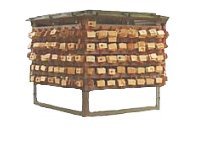
Ema

Shrine visitors write their wishes on these wooden plates and then leave them at the shrine in the hope that their wishes come true. Most people wish for good health, success in business, passing entrance exams, love or wealth.

Omikuji

Omikuji are fortune telling paper slips found at many shrines and temples. Randomly drawn, they contain predictions ranging from daikichi ("great good luck") to daikyo ("great bad luck"). By tying the piece of paper around a tree's branch, good fortune will come true or bad fortune can be averted.

Shimenawa

A shimenawa is a straw rope with white zigzag paper strips (gohei). It marks the boundary to something sacred and can be found on torii gates, around sacred trees and stones, etc. A rope similar to the shimenawa is also worn by yokozuna, the highest ranked sumo wrestlers, during ritual ceremonies.

There can be a variety of additional buildings such as the priest's house and office, a storehouse for mikoshi and other auxiliary buildings. Cemeteries, on the other hand, are almost never found at shrines, because death is considered a cause of impurity in Shinto, and in Japan is dealt with mostly by Buddhism.

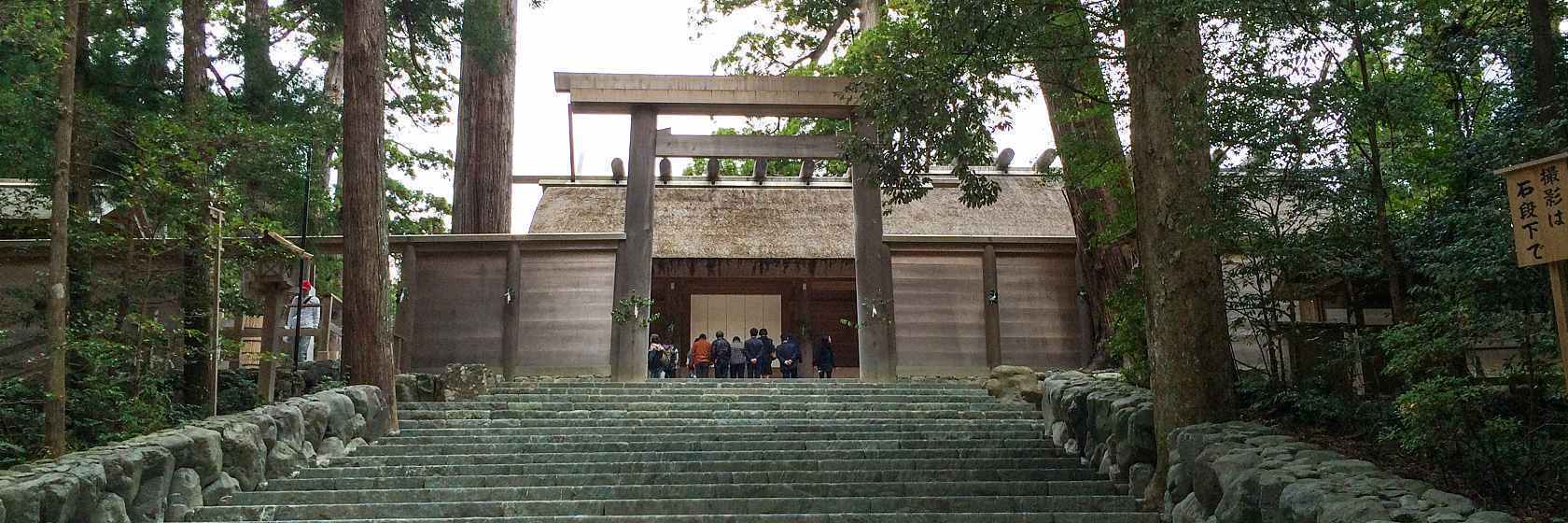
The architecture and features of Shinto shrines and Buddhist temples have melted together over the centuries. There are several construction styles, most of which show (Buddhist) influences from the Asian mainland. Only a few of today's shrines are considered to be built in a purely Japanese style. Among them are Shinto's most important shrines, the Ise Shrines.

There are tens of thousands of shrines across Japan, some of which can be categorized into a few major groups of shrines. Some of these groups are:

  • Imperial Shrines
    These are the shrines which were directly funded and administered by the government during the era of State Shinto. They include many of Shinto's most important shrines such as the Ise Shrines, Izumo Shrine and Atsuta Shrine, and a number of shrines newly built during the Meiji Period, such as Tokyo's Meiji Shrine and Kyoto's Heian Shrine. Imperial shrines can be recognized by the imperial family's chrysanthemum crest and by the fact that they are often called "jingu" rather than "jinja".

  • Inari Shrines
    Inari Shrines are dedicated to Inari, the kami of rice. They can be recognized by fox statues, as the fox is considered the messenger of Inari. There are several ten thousand Inari Shrines across Japan, among which Kyoto's Fushimi Inari Shrine is most famous.

  • Hachiman Shrines
    Hachiman Shrines are dedicated to Hachiman, the kami of war, which used to be particularly popular among the leading military clans of the past. Of Japan's thousands of Hachiman Shrines, the most famous is probably Kamakura's Tsurugaoka Hachimangu.

  • Tenjin Shrines
    Tenjin Shrines are dedicated to the kami of Sugawara Michizane, a Heian Period scholar and politician. They are particularly popular among students preparing for entrance exams. Tenjin Shrines can be recognized by ox statues and plum trees, Michizane's favorite trees. The first and most famous Tenjin Shrine is Dazaifu Tenmangu near Fukuoka.

  • Sengen Shrines
    Sengen Shrines are dedicated to Princess Konohanasakuya, the Shinto deity of Mount Fuji. More than one thousand Sengen Shrines exist across Japan, with the head shrines standing at the foot and the summit of Mount Fuji itself.

  • Shrines dedicated to the founders of powerful clans
    Some powerful clans in Japanese history established and dedicated shrines to the their clans' founders. The most famous example are the several dozens of Toshogu Shrines dedicated to Tokugawa Ieyasu, including the famous Toshogu Shrine at Nikko. Another example is Kanazawa's Oyama Shrine which is dedicated to Maeda Toshiie, the founder of the powerful, local Maeda clan.

  • Local Shrines
    Many shrines are dedicated to local kami without association to other shrines.

List of Famous Shrines
Nikko
Toshogu Shrine Lavish mausoleum of Tokugawa Ieyasu.
Futarasan Shrine Dedicated to Nikko's sacred mountains.
Tokyo
Meiji Shrine Dedicated to the deity of Emperor Meiji.
Yasukuni Shrine Dedicated to the deities of Japan's war dead.
Kamakura
Hachimangu Shrine Kamakura's most important Shinto shrine.
Zeniarai Benten Shrine where visitors wash their money.
Fujiyoshida
Sengen Shrine Important shrine at the foot of Mount Fuji.
Hakone
Hakone Shrine Hakone's most famous Shinto shrine.
Kanazawa
Oyama Shrine Shrine dedicated to the former local lord.
Nagoya
Atsuta Shrine One of Shinto's most important shrines.
Ise
Ise Shrines Japan's most sacred shrines.
Kyoto
Fushimi Inari Shrine The ultimate torii gate experience.
Heian Shrine Modeled after the ancient Imperial Palace.
Kamo Shrines Two of Kyoto's most important shrines.
Kitano Tenmangu Popular shrine hosting a monthly flee market.
Yasaka Shrine Popular shrine hosting the Gion Festival.
Osaka
Sumiyoshi Taisha Head shrine of all Sumiyoshi Shrines.
Nara
Kasuga Taisha Nara's most celebrated Shinto shrine.
Yoshino
Yoshimizu Shrine Temporary quarters of Emperor Go-Daigo.
Mikumari Shrine Shrine with an unusual architecture.
Miyajima
Itsukushima Shrine Famous shrine with floating torii gate.
Izumo
Izumo Taisha Japan's second most important shrine.
Yamaguchi
Yamaguchi Daijingu A small version of the Ise Shrines.
Kotohira
Kompirasan Shikoku's most popular shrine.
Dazaifu
Tenmangu Shrine The first shrine dedicated to Tenjin.
  best of the best    best of Japan    outstanding

Any advice or questions? Voice them in the forum!

english links

Jinja (or Shrine) (Jinja Online Network League)
Information provided by the Jinja Online Network League.
Jinja Honcho
Offivial website of the Association of Shinto Shrines.

product links

A Year in the Life of a Shinto Shrine
Book by John K. Nelson
Shinto: The Kami Way
A very informative, introductory book about most aspects of Shinto by Sokyo Ono
A Popular Dictionary of Shinto
Book by Brian Bocking
Japanese Shinto Ritual Music
Audio CD by Various Artists


January 31, 2005  
Copyright © 1996-2008 japan-guide.com All rights reserved
home - site map - privacy policy - terms of use - contact - L‚ɂ‚¢‚Ä - advertising

BuildYourJapan

Asian-inspired
Plasma TV Stands