Bonenkai and Shinnenkai
     |
Bonenkai or "Forget-the-year Parties" are held throughout December while Shinnenkai or "New Year Parties" are held in January. They are social gatherings of company workers, business and other friends that usually take place in restaurants. They are not family gatherings, and should not be confused with the New Year celebrations that take place during the Shogatsu holidays (January 1-3) and which are traditionally family events.
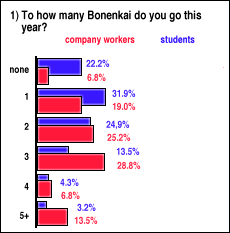
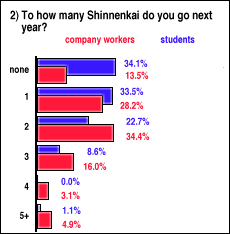
Our first question asked the survey participants at how many Bonenkai and Shinnenkai they participate this resp. next year. The results show that company workers go to more parties than students, and that there is no big difference between the genders within those two groups. They also show that Bonenkai are more numerous than Shinnenkai.
Company workers go to an average of 2.6 Bonenkai and 1.9 Shinnenkai, while students go to an average of only 1.6 Bonenkai and 1.1 Shinnenkai. The majority of company workers participate in two to three Bonenkai and one to two Shinnenkai. A majority of students, on the other hand, go to one to two Bonenkai and none or one Shinnenkai. Only 6.8 percent of the company workers responded that they do not go to any Bonenkai, while twice as many (13.5%) indicated not to go to any Shinnenkai. Among students, 22.2 percent do not go to any Bonenkai and every third does not partcipate in a Shinnenkai. On the other extreme, 13.5 percent of company workers go to five or more Bonenkai while the same is true for only 3.2 percent of students.
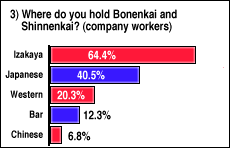
In our second question we tried to find out in what kind of restaurants the parties take place. By far the most popular place to hold Bonenkai and Shinnenkai are Izakaya with over 60 percent of replies. Izakaya are restaurants that offer drinks and various small to middle sized dishes, and offer a perfect atmosphere for such gatherings. Izakaya are followed by other Japanese style restaurants (27.8%), Western style restaurants (14.7%), bars (12.2%) and Chinese style restaurants (5.8%).
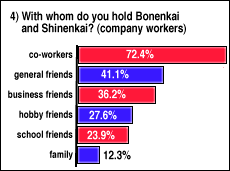
In our next question we asked with whom Bonenkai and Shinnenkai are held. As expected, the by far mostly chosen answer among company workers was co-workers (72.4%), and among students it was school friends (68.1%). Company workers also party together with other general freinds (41.1%), business friends (36.2%), friends from hobby circles (27.6%) and former classmates (23.9%).
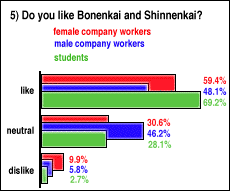
Finally, we asked the survey participants whether they like or dislike Bonenkai and Shinnenkai. The results show that students like the parties more than company workers, and that among company workers, male respondents have more neutral feelings towards the parties than their female counterparts.
A large majority of nearly 70 percent of students indicated to like Bonenkai and Shinnenkai, in contrast to only 2.7 percent who dislike them. The rest neither likes nor dislikes them. Among company workers, less people like the parties (56.9%), and more people dislike them (8.6%). The results are much more polarized among female company workers than among men. At the same time, more female (59.4%) than male (48.1%) company workers responded to enjoy the parties, and more female (9.8%) than male (5.8%) comany workers responded to dislike them.
Happy new year!
Questions? Ask in our forum.