Driving a car
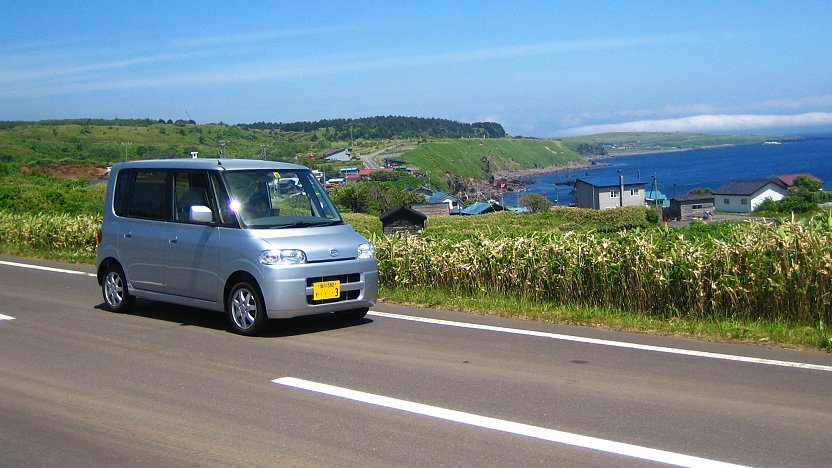
Japan's large metropolitan areas around Tokyo, Osaka and Nagoya are served by highly efficient public transportation systems. Consequently, many residents do not own a car or do not even possess a driver's license. Outside the big cities, however, public transportation tends to be inconvenient or infrequent, and most people rely on cars to get around.
Also see our guide on renting a car in Japan.
Roads and rules

Cars drive on the left side of the road and have the driver's seat and steering wheel on their right side. The legal minimum age for driving is 18 years. Drinking and driving is prohibited. Road signs and rules follow international standards, and most signs on major roads are in Japanese and English. Vehicles have to come to a full stop before crossing any railway tracks.
The typical speed limits are 80 to 100 km/h on expressways, 40 km/h in urban areas, 30 km/h in side streets and 50 to 60 km/h elsewhere; however, drivers tend to go a little over the posted speed limits.
Most roads in Japan are toll free with the exception of expressways, some scenic driving routes and a small number of toll tunnels. Road conditions tend to be good, although side streets in the cities can be rather narrow or even impassable to larger vehicles. Traffic congestion is a frequent problem in and around urban centers.
Drivers generally tend to be well mannered and considerate, however some common dangers on Japanese roads include drivers speeding over intersections even well after the traffic light has turned red, people stopping their vehicles at the edge of the road in a way in which they block traffic, and careless cyclists, especially those who ride on the wrong side of the road.

International Driving Permits
Foreigners can drive in Japan with an International Driving Permit (IDP) for a maximum of one year from the date of entry into Japan, even if the IDP is valid for a longer period. After the one year period, it is not possible to use an International Driving Permit again unless you leave Japan for at least three months in between.
International driving permits are not issued in Japan and should be obtained in your home country in advance. They are usually issued through your country's national automobile association for a small fee. Japan recognizes only international driving permits based on the 1949 Geneva Convention, which are issued by a large number of countries.
Belgium, France, Germany, Monaco, Switzerland and Taiwan do not issue permits based on the 1949 Geneva Convention, but instead have a separate agreement that allows drivers from these countries to drive in Japan with an official Japanese translation of their driver's license also for a maximum of one year. A translation can be obtained from the Japan Automobile Federation (JAF), through Driving-Japan (use voucher code "JapanGuide22" for a 5 EUR discount) or some of the respective countries' embassies or consulates in Japan.
People from other countries whose international driving permits are not recognized by Japan and people who stay in Japan for more than one year, must obtain a Japanese driver's license.

Japanese driver's licenses
Japan has bilateral agreements with more than twenty countries, including Austria, Australia, Belgium, Canada, the Czech Republic, Denmark, Finland, France, Germany, Greece, Hungary, Iceland, Ireland, Italy, Luxembourg, Monaco, the Netherlands, New Zealand, Norway, Poland, Portugal, Slovenia, South Korea, Spain, Sweden, Switzerland, Taiwan and the United Kingdom, as well as the US states of Colorado, Hawaii, Indiana, Maryland, Ohio, Oregon, Virginia and Washington, to ease the process of acquiring a Japanese license. If you hold a valid driver's license from one of these countries you can get a Japanese license without taking a written or practical exam (holders of a license from the US state of Indiana are exempt from the practical but not the written exam).
Instead, go to your local license center with an official translation of your license (obtainable from the Japan Automobile Federation), your passport, and proof that you held your license for at least three months in the issuing country before coming to Japan. Then, take a basic eye and physical test and you will be issued a new license on the same day.
If you have a driver's license from a country or state which does not have an agreement with Japan, such as China, Brazil or most US states, you will have to take a written and practical exam in order to obtain a Japanese driver's license. This process typically takes several attempts, even for experienced drivers.

Buying and owning a car
Japanese cars are classified into regular and light (keijidosha) cars, which are subject to different taxes and regulations. Keijidosha cars (yellow license plates) are smaller vehicles that must conform to strict size, weight and power restrictions. In return, they enjoy several tax and toll breaks, and relaxed ownership regulations that make them cheaper and easier to own than regular cars (white license plates).
Owning and operating a car involves numerous expenses, including compulsory inspections (shaken) every two to three years, yearly automobile taxes, mandatory and optional insurance, parking fees, toll expressways and gasoline cost.
Shaken is a compulsory safety inspection, which cars in Japan have to undergo every two years, except new cars, for which the first inspection is not due until three years after purchase. Shaken typically costs between 100,000 and 200,000 yen, and besides the actual inspection fee, includes a weight tax (typically 8,000 to 50,000 yen) and mandatory insurance (about 30,000 yen).
Since the mandatory insurance does not provide full coverage, it is recommended to purchase additional, secondary car insurance. Furthermore, the annual automobile tax, which depends on the engine size, typically costs between 10,000 and 50,000 yen. An acquisition tax also has to be paid when you buy a new car.
Numerous documents are required to purchase a car, including forms to register your car and to verify ownership of a parking space. Used cars additionally require a transfer of ownership. Keijidosha cars enjoy more relaxed transfer processes. Fortunately, if you buy a car through a car dealer, they will handle most of the paperwork for you, while your main task is to sign the forms with your officially registered, personal stamp (inkan).

Gas stations
Gas stations are found all across Japan. They traditionally provide full service, although self service stations have greatly increased over recent years. Many gas stations close during the night, while others are open 24 hours. A liter of regular gasoline costs roughly 180 yen (as of March 2025). High octane gas and diesel are also widely available. Payment is possible by credit card or cash.
Getting gas at a full service (フル) station requires some simple Japanese. When you pull into the station, an attendant may direct you to a stall. Park, open your window and shut off your car. Tell the attendant what kind of gas (e.g. "regular"), how much (e.g. "mantan" for full tank) and how you will pay (e.g. "credit card"). He may give you a wet towel to clean your dash or ask to take your garbage. When finished he may ask which direction you wish to leave and then direct you out into traffic.
Self service (セルフ) stations usually provide only Japanese language menus. If in trouble, an attendant should be present and able to help you. Note that when paying by cash, the change machine is often a separate machine or inside the gas station building.

Parking
Parking in the center of large cities is very expensive, costing several hundreds of yen per hour. Fees decrease with the size of the city and the distance to the city center. In small towns and in the countryside, parking is often free. Parking lots in national parks or near tourist attractions sometimes charge a flat fee (typically 200 to 500 yen per use). Urban hotels usually provide parking for their guests at a flat rate (typically 1000 yen per night), while hotels outside the large cities usually offer free parking.
Besides standard parking lots, you may encounter a few unique types of parking lots in Japan. The first are elevator parking lots in which cars are stored in towers. Drivers are directed to park their car onto a lift, which will automatically store the car in the tower. When coming back, the car will be fetched by the lift and returned to you.
The second unique type of parking lot uses low barriers underneath the cars which raise up to physically block in each individual vehicle. Once you have paid your parking fee (either at a central payment machine or at the parking space), the barrier lowers and you can safely drive away. This type of parking lot is usually seen around small urban lots.

Questions? Ask in our forum.