The first Europeans to Japan came from Portugal and landed on Kyushu in western Japan in 1542, bringing gunpowder and Christianity along with them. Some lords, especially on Kyushu, and Japan's upcoming leader Oda Nobunaga welcomed the new visitors for the weapons they brought with them and tolerated the missionaries that came as part of the package.
The missionaries were eventually successful in converting considerable numbers of people in western Japan, including members of the ruling class. Christianity could be practiced openly, and in 1550, Francis Xavier visited Kyoto to seek an audience with the Emperor.
However in 1587, in an era of European conquest and colonization, including in the Philippines near Japan, Toyotomi Hideyoshi issued an edict banning missionaries from the country due to the religion's political ambitions, intolerant behavior towards Shinto and Buddhism, and connections to the sale of Japanese people as slaves overseas. In 1597, Hideyoshi proclaimed a more serious banning edict and executed 26 Christians in Nagasaki as a warning.
Intent to bring Japan under complete control, the succeeding Tokugawa Shogunate further hardened the country's anti-Christian stance, accusing the religion of obstructing the authorities, antisocial behavior and intolerance towards the established religions. After a rebellion on the Shimabara Peninsula that involved many Christians in the late 1630s, thousands of rebels were executed and a full ban on Christianity became strictly enforced. Only small pockets of "Hidden Christians" continued practicing their religion in secret.
Statues used by the hidden Christians to practice their religion in secret
Following the Meiji Restoration, freedom of religion was promulgated and the number of Japanese Christians has been slowly increasing again. Today, about one to two million Japanese are Christians (about one percent of Japan's population), and churches can be found across the country. Many Christians live in western Japan where the missionaries' activities were greatest during the 16th century.
A few Christian customs that have become popular among the non-Christian population in modern-day Japan include Christian-style wedding ceremonies, at which brides wear white wedding dresses and the couple exchange their vows at wedding chapels.
Christmas Cake
Events like Valentine's Day and Christmas have developed secular status, and retail marketing for these celebrations contribute to their popularity. Seasonally appropriate gifts and decorations start lining the shelves weeks in advance, and illumination events are held. Note that while commonly celebrated by the populace, Valentine's Day and Christmas are not national holidays in Japan.
The following is a list of tourist sites related to Christianity in Japan:
The isolated location of Amakusa and the fact that the islands are close to where Europeans used to enter Japan in the old days, allowed missionaries to convert many inhabitants and even the local lord to Christianity before the religion was banned in the early Edo Period. Today there are numerous museums and churches spread across the islands which reflect this religious heritage.
Just north of Amakusa, the Shimabara Peninsula was also ruled by a Christian lord into the early Edo Period. The peninsula later became the site of the Shimabara Rebellion, a major uprising by peasants from Amakusa and Shimabara - many of whom were Christians - that was forcefully ended by shogunate forces at Hara Castle.
Considered the oldest Christian church in Japan, the Oura Catholic Church in Nagasaki was constructed in the last years of the Edo Period and initially catered to the city's foreign community.
During the ban on Christianity, several Christians resettled to the remote Sotome coast north of Nagasaki City to practice their religion in secret. When the ban was lifted in the late 1800s, many of them rejoined the Catholic Church and constructed churches with the support of foreign priests.
The isolated Kuroshima Island off the coast of Sasebo was another place where many hidden Christians lived during the ban on Christianity. After freedom of religion had been granted, the local parish erected an impressive, Romanesque-style church in the center of the island's town.
Hirado in northern Nagasaki Prefecture is another place where communities of hidden Christians practiced their religion in secret in isolated villages through the ban on Christianity. After the end of the ban, several churches were constructed on the island, and a couple of local museums are now dedicated to their history.
The remote Goto Island chain was another place where hidden Christians resided. After the ban on the religion was lifted, large numbers of churches were built on the islands, especially on the most populated islands of Fukue and Nakadori.
The St. Francis Xavier Memorial Church in Yamaguchi was built in 1952 and commemorates the Jesuit missionary Francis Xavier, who was active in spreading Christianity to Asia in the 1500s. The current building was reconstructed in 1998 after the original was destroyed in a fire. Religious artwork and Xavier's travel history are on display in the museum inside the church.
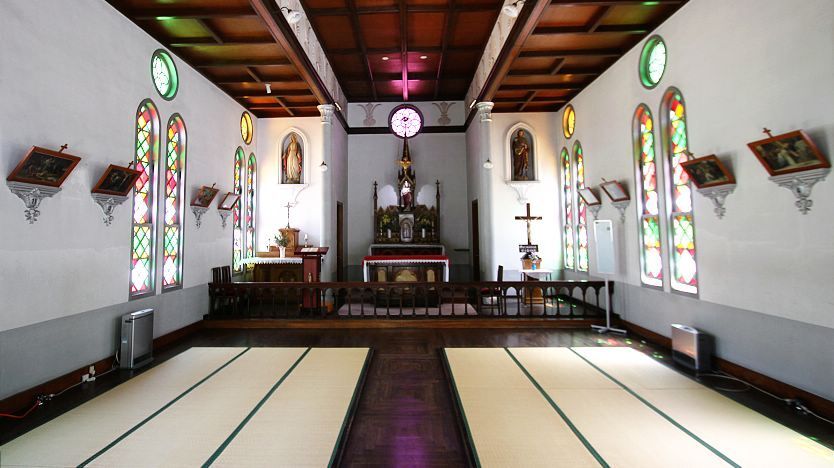
The Tsuwano Catholic Church in Tsuwano was built in 1931 by a Catholic priest from Germany. The church features tatami mats instead of pews. Next to the church stands a small museum with exhibits related to the Christians who were relocated to and persecuted in Tsuwano in the period between the opening of the country in the 1850s and the granting of freedom of religion in 1873.
The Otome Toge Maria Chapel (Maria Seido Chapel) in Tsuwano, was built in 1951 in memory of Christians who were relocated to and persecuted there in the late 1800s. Christianity was prohibited in Japan during the Edo Period until 1873, about five years after the Meiji Restoration, and some Christians who openly professed their faith before that date were still prosecuted.
The Saint Nicolai Church, the main cathedral of the Japanese Orthodox Church, was built in 1891 after Saint Nikolai moved the Orthodox Church headquarters from Hakodate to Tokyo. The current building was reconstructed in 1929 after the original cathedral had been damaged in the 1923 Great Kanto Earthquake. The church has been popular since the Meiji Period for its Byzantine architecture featuring a domed roof and a bell tower.
The Stone Church in Karuizawa is an excellent work of architecture. The stone structure blends into the surrounding woods; its appearance like a scene from a fairy tale, inviting people to take a closer look. The church's interior is equally imaginative and charming - the reason why this is a popular venue for weddings. When not used for weddings, the Stone Church is open to the public.
Christ's Grave is an unusual site 25 kilometers east of Lake Towada where the purported grave of Jesus Christ lies. The claim is widely regarded as an unfounded legend despite the existence of "ancient religious papers" which explain that Jesus actually fled to Japan where he lived his final years and eventually died.
The Russian Orthodox Church in Hakodate was established in 1859, and the current building was constructed in 1916. It was the first Orthodox Church in Japan as well as the headquarters of the Japanese Orthodox Church. The church remains one of the more famous, foreign-looking buildings in Hakodate's Motomachi District.