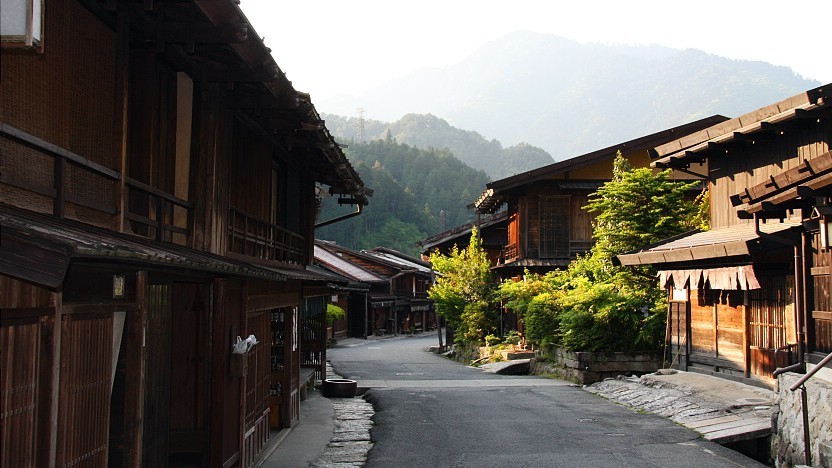
Tsumago (�ÈâÄ) was a post town on the Nakasendo route between Kyoto and Edo. It is known today as one of the best preserved post towns in Japan. The town and its residents go to great lengths to recreate the ambience of the Edo Period. Cars are prohibited on the main street in the day and phone lines and power cables are kept concealed, allowing visitors to imagine they have slipped back to an earlier time.
Tsumago also recreates the post town atmosphere by maintaining its Honjin and Wakihonjin. In post towns, the Honjin was the principal inn and served government officials who were traveling through. When more lodging was required, the Wakihonjin served to accommodate the travelers of slightly lower status. Tsumago also maintains the office where laborers and horses were rented to aid in travel.

Many minshuku and ryokan are located in the town, and a stay at one of them will greatly add to the illusion of having left the modern era. If time permits, it is highly recommended to hike a preserved trail of the former Nakasendo from Tsumago to Magome. It is well maintained and well marked in both Japanese and English.


Getting there and around
Tsumago is connected by bus with JR Nagiso Station, the closest train station. The one way ride takes about seven minutes and costs 300 yen (see timetable). Alternatively, a taxi ride costs about 2000 yen. You can also walk between Nagiso Station and Tsumago in about an hour along a marked walking trail.
With a few exceptions, most limited express trains between Nagoya and Nagano do not stop at Nagiso Station. Instead, transfer to a local train at Nakatsugawa or Kiso-Fukushima Station.
Nearby Magome can be reached from Tsumago by infrequent direct buses (see timetable) or by following the Magome-Tsumago Hiking Trail.
How to get to and around the Kiso Valley

Questions? Ask in our forum.