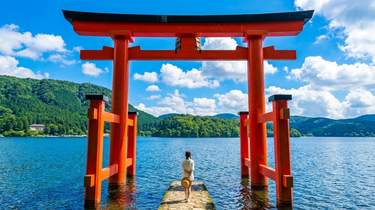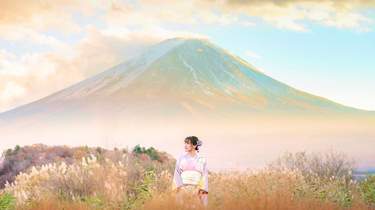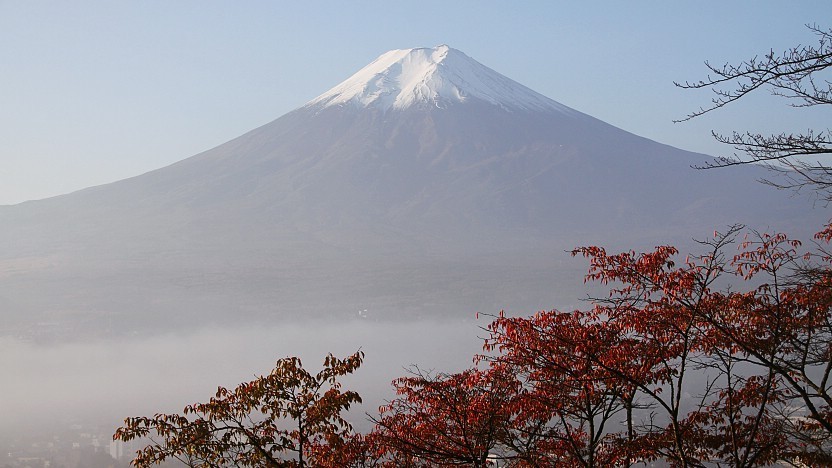
Climbing Mount Fuji (3776 meters), Japan's highest and most prominent mountain, can make for lifelong memories. The mountain itself may look more attractive from afar than from close up, but the views on clear days and the experience of climbing through the early morning hours among hundreds of equally minded hikers from across the world are very rewarding.
What is new in 2026?
The 2026 rules follow mostly last year's rules. Like last year, the fee for hiking Mount Fuji will be 4000 yen per person. Prospective hikers are asked to make online reservations and payments ahead of time. A daily limit of 4000 hikers will be maintained on the Yoshida Trail, but note that this number was not reached on any day in 2025 and 2024.
Like last year, the trailheads will be closed from 2pm to 3am, except for hikers staying at huts. The aim is to prevent people from climbing through the night, which is blamed by the local authorities to cause an increased number of troubles on the mountain.
The 2026 rules more clearly state that all hikers on the Yoshida Trail will be checked for three mandatory items at the trailhead, in an effort to reduce problems caused by poorly prepared climbers. Hikers who do not bring the following three items will be turned back:
- Trekking shoes
- Cold weather clothing
- Rainwear
In a change from past years, the Subashiri Trail is scheduled to open from July 1 this year (instead of July 10), like the Yoshida Trail, which it merges with. However, the Fujinomiya and Gotemba trails remain closed until July 10.
When to climb?
Official climbing season
Early July to mid September is the official climbing season when the trails and mountain facilities are open. During this period the mountain is usually free of snow, the weather is relatively mild, access by public transportation is easy, and the mountain huts are open. In recent years the official season has been set as follows:
- Yoshida and Subashiri trails: July 1 to September 10
- Fujinomiya and Gotemba trails: July 10 to September 10
The crowds
Climbing Mount Fuji is very popular not only among Japanese but also foreign tourists, who make up a significant minority of hikers. The peak season for climbing Mount Fuji is during the school vacations, which last from around July 20 to the end of August. The peak of the peak is reached during the Obon Week in mid August and on weekends (especially Saturdays), when climbers literally have to stand in queues at some passages.
A daily limit of 4000 hikers is maintained along the Yoshida Trail, the most popular of the four trails leading up to the summit, and an online system allows for advance reservations of hiking slots. Note that in past years, this number has been exceeded only on a few particularly busy days. No limits are set along the other three trails.
While we recommend to avoid the super busy days, we believe that by avoiding the crowds in general, you would miss out one of the most interesting aspects of climbing Mount Fuji, which is the camaraderie and unique experience of ascending the mountain among hundreds of equally minded people from across the world.
In order to encounter neither too large nor too small crowds, we recommend to climb Mount Fuji on a weekday in the first half of July before the start of the school vacations. The downside of a climb in early July is the weather, which tends to be more unstable than later in the season.
Off-season
Climbing Mount Fuji above the 5th stations outside of the official climbing season is prohibited by law. The trails are not maintained, huts are closed, food unavailable, and conditions can be highly perilous due to extreme wind and weather, snow, ice and a risk of avalanches.

The trails
Mount Fuji is divided into ten stations with the first station at the foot of the mountain and the tenth station being the summit. Paved roads go as far as the fifth station halfway up the mountain. There are four 5th stations on different sides of the mountain, from where most people start their ascent:
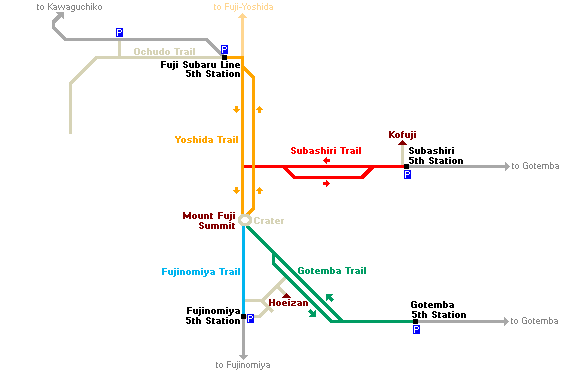
- Fuji Subaru Line 5th Station (Yamanashi Prefecture)
Yoshida Trail
Altitude: about 2300 meters
Ascent: 5-7 hours
Descent: 3-5 hours
Daily limit: 4000 hikers
This is the most popular base for the climb to the summit, and the most easily accessible 5th station from the Fuji Five Lake region and central Tokyo. Lots of mountain huts line the trail around the 7th and 8th stations, and there are separate trails for the ascent and descent. The sunrise takes place on this side of the mountain. More details... - Subashiri 5th Station (Shizuoka Prefecture)
Subashiri Trail
Altitude: about 2000 meters
Ascent: 5-8 hours
Descent: 3-5 hours
No daily limit
This 5th station at only 2000 meters above sea is the base of the Subashiri Trail, which meets the Yoshida Trail around the 8th station. More details... - Gotemba 5th Station (Shizuoka Prefecture)
Gotemba Trail
Altitude: about 1400 meters
Ascent: 7-10 hours
Descent: 3-6 hours
No daily limit
This is by far the lowest 5th station, and the ascent to the summit is accordingly much longer than from the other 5th stations. There are about four huts around the 7th and 8th stations. More details... - Fujinomiya 5th Station (Shizuoka Prefecture)
Fujinomiya Trail
Altitude: about 2400 meters
Ascent: 4-7 hours
Descent: 2-4 hours
No daily limit
The closest 5th station to the summit, the Fujinomiya 5th Station is the base for the southern approach via the Fujinomiya Trail. It is easily accessible from stations along the Tokaido Shinkansen. There are half a dozen mountain huts along this trail. More details...

How to climb?
Is it difficult?
The ascent to the summit does not pose any major difficulties regarding climbing skills. Only at some points the terrain is rather steep and rocky. Abundant signs along the trail warn the hikers of other minor problems such as sudden wind gusts and falling rocks. However, the main challenge of the climb is the fact that it is very long and strenuous and the air gets notably thinner as you gain altitude.
Is it recommended to hire a guide?
Because the hike is not technically difficult, and there are many other hikers during the climbing season, the average person will not need a guide. However, inexperienced hikers or people who prefer to leave all the planning to somebody else may want to consider hiring a guide. There are several companies offering group or private tours, such as Klook and Willer.
Timing
Most people try to time their ascent in order to witness the sunrise from the summit. Also, the chances of the mountain being free of clouds are highest during the early morning hours.
The recommended way of doing this, is to climb to a mountain hut around the 7th or 8th station on the first day and spend some hours sleeping there before continuing to the summit early on the second day. Sunrise in summer is as early as 4:30am to 5:00am.
In the past, many hikers started climbing the mountain in the late evening from the 5th Station and hiked through the night to reach the summit around sunrise. Known as "bullet climbing", this way of climbing Mount Fuji, however, is blamed by local authorities for an increased number of troubles on the mountain because it is more tiring and brings an increased risk of altitude sickness and injury. For this reason, the trailheads are closed between 2pm to 3am to prevent people from hiking overnight. Only hikers with a hut reservation are allowed to start their ascent between 2pm to 3am.
Ascending and descending the mountain in a single day during daytime is also possible, but again it is not recommended for the same reasons as above. Furthermore, the mountain provides very little shelter, leaving climbers fully exposed to the sun. Visibility also tends to be worse during daytime when the mountain is frequently wrapped in clouds.
A walk around the crater of Mount Fuji takes about one hour. The mountain's and Japan's highest point is located immediately next to the weather station on the opposite side from where the Yoshida Trail reaches the peak.
Mountain huts
The Yoshida Trail is lined by more than a dozen mountain huts between the 7th and 8th stations. Other trails have fewer mountain huts. An overnight stay costs typically around 13,000 to 15,000 yen per person with two meals. Expect the huts to be extremely crowded during the peak. Reservations should be made in advance; however, a considerable number of huts don't accept reservations online or in English or sell out quickly. Check the external links below for lists of mountain huts.
Most mountain huts offer paid toilets (typically 200-300 yen for non-staying guests) and sell food, water and other climbing provisions such as canned oxygen. In addition, most of the huts have special branding irons they use to brand the wooden hiking sticks (for a small fee) that many hikers purchase when climbing the mountain.

Climbing equipment
In order to enjoy a safe hike to the summit of Mount Fuji, it is crucial to bring the proper equipment. Some of the most important things to bring are listed below:
- Proper shoes
The rocky, steep terrain in some sections and the potential of sudden, strong wind gusts are reasons to bring proper hiking shoes which protect your ankles. - Proper clothes
Bring proper protection against low temperatures and strong winds. It can be below zero at the summit, and strong winds often make it even colder. Bring rain gear, as weather conditions can change very quickly on the mountain. Gloves are recommended both against the coldness and for hiking the steep, rocky passages. - Flashlight
If you hike at night, a flash light is highly recommended in any season and essential outside of the peak season when the trail is not illuminated by other hikers. Most people choose head lamps, as they leave both of your hands free. - Food
It is important to bring enough water and food, particularly on the trails where there are few mountain huts along the way. Mountain huts offer various meals and drinks; however, note that prices increase with the altitude. Also, be prepared to carry home all your garbage as there are no public garbage bins on the mountain. - Money
Cash is necessary to buy provisions on the mountain like water or canned oxygen and to use the toilets along the way. It is also important to carry should you need to seek emergency shelter in one of the mountain huts. - Hiking stick (optional)
While not crucial, many hikers purchase wooden hiking sticks at the 5th Station to aid in their climb up the mountain. Hiking sticks cost about 1500-2000 yen and are sold at the 5th stations. In addition, for a few hundred yen you can get your hiking stick branded at the mountain huts along the way, turning it into a much cherished souvenir of your journey.
Manners
- Do not pick plants!
- Do not bring home any stones!
- Do not camp on the mountain!
Admission fee
The admission fee on all trails is 4000 yen. Prospective hikers are asked to make online reservations and payments ahead of time:
Same-day purchases are possible at the trailhead, but note that there is a daily limit of 4000 hikers on the Yoshida Trail, which can be surpassed on particularly busy days.
Altitude sickness
The human body requires some time to adjust to a sudden increase of altitude, otherwise there is a risk of headache, dizziness and nausea. Quite a few people who climb Mount Fuji, suffer from altitude sickness.
To avoid altitude sickness, you are advised to tackle the mountain at a slow pace, stay hydrated and make frequent breaks. An overnight stay at a hut around the 7th or 8th station is recommended as opposed to a straight climb to the top. Small bottles of oxygen, available at the 5th stations and mountain huts, can be an effective tool in preventing and fighting altitude sickness; however, the only reliable treatment is to descend the mountain.

Getting there and around
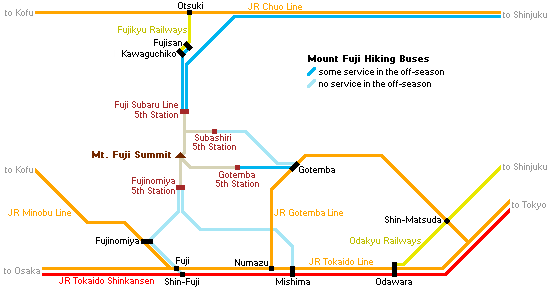
Buses to Fuji Subaru Line 5th Station
From Fujisan/Kawaguchiko Station:
1950 yen (one way), 3000 yen (round trip), 50 minutes
Hourly buses during the 2025 climbing season.
5-7 round trips per day during the 2025 off-season.
Bus timetable (climbing season)
Bus timetable (off-season)
How to get to Kawaguchiko Station
More about the Fuji Subaru Line 5th Station
From Shinjuku Station (Tokyo):
3800 yen (one way), 150 minutes
Hourly buses during the 2025 climbing season.
2-3 round trips per day during the 2025 off-season.
Bus timetable (climbing season)
Bus timetable (off-season)
Buses to Subashiri 5th Station
From Gotemba Station:
1800 yen (one way), 2500 yen (round trip), 60 minutes
Every 1-2 hours during the 2025 climbing season.
No off-season service in 2025.
Bus timetable (climbing season)
More about the Subashiri 5th Station
Buses to Gotemba 5th Station
From Gotemba Station:
1280 yen (one way), 2300 yen (round trip), 30 minutes
Every 2-3 hours during the 2025 climbing season.
3 round trips on weekends and holidays in autumn 2025.
Bus timetable (climbing season)
Bus timetable (off-season)
More about the Gotemba 5th Station
Buses to Fujinomiya 5th Station
From Shin-Fuji and Fujinomiya Stations:
2740 yen (one way), 4000 yen (round trip), 120 minutes from Shin-Fuji Station
2330 yen (one way), 4000 yen (round trip), 90 minutes from Fujinomiya Station
6 round trips per day during the 2025 climbing season.
No off-season service in 2025.
Bus timetable (climbing season)
How to get to Fujinomiya
More about the Fujinomiya 5th Station
From Mishima Station:
3500 yen (one way), 90 minutes from Mishima Station
6 round trips per day during the 2025 climbing season.
No off-season service.
Bus timetable (climbing season)
Access by car
The access roads to the Fuji Subaru Line 5th Station, the Subashiri 5th Station and the Fujinomiya 5th Station are closed to regular cars during the climbing season, and access is possible only by bus, taxi or shuttle buses from designated large parking lots near the base of the mountain. Please see the respective pages for more details.
Questions? Ask in our forum.
Links and Resources
Hotels around Mount Fuji

-
-
![]() TaiheikanWell situated in the Fujikawaguchiko Onsen-kyo district of Fujikawaguchiko, Taiheikan is set 2 km from Lake Kawaguchi, 3.8 km from Fuji-Q Highland and 25 km from Mount Fuji. Each accommodation at the 3-star ryokan has mountain views, and guests can enjoy access to a hot spring bath and a public bath. The ryokan offers rooms with air conditioning, free private parking and free WiFi. At the ryokan, the units are equipped with a tatami. A fridge and kettle are also featured. At the ryokan, each unit comes with a flat-screen TV and a safety deposit box. The ryokan is located in a geothermal area, with a number of hot springs nearby for guests to relax in. Popular points of interest near the ryokan include Lake Kawaguchi Ohashi Bridge, Mount Kachi Kachi Ropeway and Fujiomuro Sengen Shrine. Shizuoka Airport is 122 km away.View on Booking.com
TaiheikanWell situated in the Fujikawaguchiko Onsen-kyo district of Fujikawaguchiko, Taiheikan is set 2 km from Lake Kawaguchi, 3.8 km from Fuji-Q Highland and 25 km from Mount Fuji. Each accommodation at the 3-star ryokan has mountain views, and guests can enjoy access to a hot spring bath and a public bath. The ryokan offers rooms with air conditioning, free private parking and free WiFi. At the ryokan, the units are equipped with a tatami. A fridge and kettle are also featured. At the ryokan, each unit comes with a flat-screen TV and a safety deposit box. The ryokan is located in a geothermal area, with a number of hot springs nearby for guests to relax in. Popular points of interest near the ryokan include Lake Kawaguchi Ohashi Bridge, Mount Kachi Kachi Ropeway and Fujiomuro Sengen Shrine. Shizuoka Airport is 122 km away.View on Booking.com -
![]() Kawaguchiko Lakeside HotelLocated just a minute's walk from Kawaguchiko Lake, Kawaguchiko Lakeside Hotel offers accommodation in Fujikawaguchiko, near Kawaguchiko Ohashi Bridge. Free WiFi is available throughout the entire property. The hotel is a minutes' walk away from the shores of Kawaguchiko and Kawaguchiko Herbkan. The hotel offers shuttle service from Kawaguchiko Station, which takes 5-minutes to the hotel. Fuji-Q Highland is a 10-minute drive away, while Fujimuro-sengen Shrine is a 15-minute drive away. Mt. Fuji 5th Station is an hour bus ride from Kawaguchiko Station. All rooms come with a flat-screen TV. For your comfort, you will find slippers and a hair dryer. There is free shuttle service at the property. Oike Park is a 2-minute walk away, while Yamanashi Gem Museum is a 4-minute walk from Lakeside Hotel Kawaguchiko.View on Booking.com
Kawaguchiko Lakeside HotelLocated just a minute's walk from Kawaguchiko Lake, Kawaguchiko Lakeside Hotel offers accommodation in Fujikawaguchiko, near Kawaguchiko Ohashi Bridge. Free WiFi is available throughout the entire property. The hotel is a minutes' walk away from the shores of Kawaguchiko and Kawaguchiko Herbkan. The hotel offers shuttle service from Kawaguchiko Station, which takes 5-minutes to the hotel. Fuji-Q Highland is a 10-minute drive away, while Fujimuro-sengen Shrine is a 15-minute drive away. Mt. Fuji 5th Station is an hour bus ride from Kawaguchiko Station. All rooms come with a flat-screen TV. For your comfort, you will find slippers and a hair dryer. There is free shuttle service at the property. Oike Park is a 2-minute walk away, while Yamanashi Gem Museum is a 4-minute walk from Lakeside Hotel Kawaguchiko.View on Booking.com -
![]() Minshuku IwakiLocated in Fujikawaguchiko and only 1 km from Lake Kawaguchi, Minshuku Iwaki provides accommodation with mountain views, free WiFi and free private parking. The 2-star guest house features lake views and is 3.9 km from Fuji-Q Highland. The guest house has family rooms. At the guest house, each unit is equipped with a tatami and a flat-screen TV. The guest house is located in a geothermal area, with a number of hot springs nearby for guests to relax in. Guests can also relax in the garden. Mount Fuji is 24 km from the guest house, while Fujiomuro Sengen Shrine is 1.1 km away. Shizuoka Airport is 121 km from the property.View on Booking.com
Minshuku IwakiLocated in Fujikawaguchiko and only 1 km from Lake Kawaguchi, Minshuku Iwaki provides accommodation with mountain views, free WiFi and free private parking. The 2-star guest house features lake views and is 3.9 km from Fuji-Q Highland. The guest house has family rooms. At the guest house, each unit is equipped with a tatami and a flat-screen TV. The guest house is located in a geothermal area, with a number of hot springs nearby for guests to relax in. Guests can also relax in the garden. Mount Fuji is 24 km from the guest house, while Fujiomuro Sengen Shrine is 1.1 km away. Shizuoka Airport is 121 km from the property.View on Booking.com -
![]() Fufu KawaguchikoSet in Fujikawaguchiko, 4.3 km from Lake Kawaguchi, Fufu Kawaguchiko offers accommodation with a garden, free private parking, a shared lounge and a terrace. Among the facilities of this property are a restaurant, room service and a 24-hour front desk, along with free WiFi throughout the property. Guests can use the sauna and the hot spring bath, or enjoy mountain views. The hotel will provide guests with air-conditioned rooms offering a desk, a kettle, a fridge, a minibar, a safety deposit box, a flat-screen TV, a balcony and a private bathroom with a bidet. Fufu Kawaguchiko features certain units with lake views, and all rooms are fitted with a patio. The units feature a wardrobe. Guests at the accommodation will be able to enjoy activities in and around Fujikawaguchiko, like cycling. Fuji-Q Highland is 7.1 km from Fufu Kawaguchiko, while Mount Fuji is 28 km away. Tokyo Haneda Airport is 124 km from the property.View on Booking.com
Fufu KawaguchikoSet in Fujikawaguchiko, 4.3 km from Lake Kawaguchi, Fufu Kawaguchiko offers accommodation with a garden, free private parking, a shared lounge and a terrace. Among the facilities of this property are a restaurant, room service and a 24-hour front desk, along with free WiFi throughout the property. Guests can use the sauna and the hot spring bath, or enjoy mountain views. The hotel will provide guests with air-conditioned rooms offering a desk, a kettle, a fridge, a minibar, a safety deposit box, a flat-screen TV, a balcony and a private bathroom with a bidet. Fufu Kawaguchiko features certain units with lake views, and all rooms are fitted with a patio. The units feature a wardrobe. Guests at the accommodation will be able to enjoy activities in and around Fujikawaguchiko, like cycling. Fuji-Q Highland is 7.1 km from Fufu Kawaguchiko, while Mount Fuji is 28 km away. Tokyo Haneda Airport is 124 km from the property.View on Booking.com -
![]() HOSHIFULL DOME FUJIOffering barbecue facilities and inner courtyard view, HOSHIFULL DOME FUJI is located in Fujikawaguchiko, 3.2 km from Fuji-Q Highland and 5.2 km from Lake Kawaguchi. With a garden, the 2-star luxury tent has air-conditioned rooms with free WiFi, each with a shared bathroom. Private parking can be arranged at an extra charge. The units are equipped with a fridge, kitchenware, a kettle, a bidet, slippers and a desk. A terrace with an outdoor dining area and garden views is offered in all units. At the luxury tent, all units are equipped with bed linen and towels. As an added convenience, the luxury tent offers packed lunches for guests to bring on excursions and other trips off-property. Outdoor play equipment is also available for guests at HOSHIFULL DOME FUJI. Mount Fuji is 21 km from the accommodation, while Lake Kawaguchi Ohashi Bridge is 4.3 km away. Shizuoka Airport is 122 km from the property.View on Booking.com
HOSHIFULL DOME FUJIOffering barbecue facilities and inner courtyard view, HOSHIFULL DOME FUJI is located in Fujikawaguchiko, 3.2 km from Fuji-Q Highland and 5.2 km from Lake Kawaguchi. With a garden, the 2-star luxury tent has air-conditioned rooms with free WiFi, each with a shared bathroom. Private parking can be arranged at an extra charge. The units are equipped with a fridge, kitchenware, a kettle, a bidet, slippers and a desk. A terrace with an outdoor dining area and garden views is offered in all units. At the luxury tent, all units are equipped with bed linen and towels. As an added convenience, the luxury tent offers packed lunches for guests to bring on excursions and other trips off-property. Outdoor play equipment is also available for guests at HOSHIFULL DOME FUJI. Mount Fuji is 21 km from the accommodation, while Lake Kawaguchi Ohashi Bridge is 4.3 km away. Shizuoka Airport is 122 km from the property.View on Booking.com -
![]() Fujikawaguchiko Onsen KonansoFeaturing great views of Mount Fuji and Lake Kawaguchi, Konanso boasts natural hot spring baths and large Japanese-style rooms with traditional tatami (woven-straw) flooring. It is only a 2-minute walk from a ferry stop, where guests can board sightseeing cruises. Free WiFi is offered in all areas. Konanso offers indoor and outdoor hot spring baths, a private-use bath (charges apply), and a foot bath on the rooftop. Relaxing massage services can be arranged. Other facilities include karaoke rooms and a lounge bar. A souvenir shop can be found on the ground floor. Guest rooms at Konanso are fitted with futon bedding, a seating area and a flat-screen TV. A Fridge and an electric kettle are also provided. Guests can try on Yukata robes or enjoy free green tea in their room. Some rooms feature an open-air hot spring bath. The property is a 10-minute drive from Kawaguchiko Train Station. A free pick-up service from the station is available upon request. Mount Fuji 5th Station for climbing is a 1-hour bus ride from Kawaguchiko Station. Popular Fuji-Q Highland Amusement Park is a 5-minute drive away, while Gotemba Outlet Shopping Mall can be reached within a 40-minute drive. Seasonal Japanese multi-course meals are served either in a private dining room or in the guestroom. Breakfast can be enjoyed at the dining room.View on Booking.com
Fujikawaguchiko Onsen KonansoFeaturing great views of Mount Fuji and Lake Kawaguchi, Konanso boasts natural hot spring baths and large Japanese-style rooms with traditional tatami (woven-straw) flooring. It is only a 2-minute walk from a ferry stop, where guests can board sightseeing cruises. Free WiFi is offered in all areas. Konanso offers indoor and outdoor hot spring baths, a private-use bath (charges apply), and a foot bath on the rooftop. Relaxing massage services can be arranged. Other facilities include karaoke rooms and a lounge bar. A souvenir shop can be found on the ground floor. Guest rooms at Konanso are fitted with futon bedding, a seating area and a flat-screen TV. A Fridge and an electric kettle are also provided. Guests can try on Yukata robes or enjoy free green tea in their room. Some rooms feature an open-air hot spring bath. The property is a 10-minute drive from Kawaguchiko Train Station. A free pick-up service from the station is available upon request. Mount Fuji 5th Station for climbing is a 1-hour bus ride from Kawaguchiko Station. Popular Fuji-Q Highland Amusement Park is a 5-minute drive away, while Gotemba Outlet Shopping Mall can be reached within a 40-minute drive. Seasonal Japanese multi-course meals are served either in a private dining room or in the guestroom. Breakfast can be enjoyed at the dining room.View on Booking.com -
![]() Mizno HotelOffering beautiful Mount Fuji views from all rooms, public baths, and restaurants, Mizno Hotel is a 5-minute drive from Kawaguchiko Train Station. Located on a hilltop and overlooking Lake Kawaguchi, the hotel serves French dinner with an advance reservation. Guests at Mizno Hotel can sleep in Western-style beds, or experience traditional futon bedding on a tatami (woven-straw) floor in one of the Japanese-style rooms. All rooms are air-conditioned and have an LCD TV and Yukata robes. The shore of Lake Kawaguchi is a 2-minute walk. Fuji-Q Highland amusement park and Fuji-Omuro Sengen Shrine are less than a 15-minute drive from the hotel. On-site parking is free, and free pick-up from Kawaguchiko Station is offered from 14:00-18:00. Mount Fuji 5th Station for climbing is a 1-hour bus ride from Kawaguchiko Station. Guests can relax in the sauna or in the private open-air bath. The hotel has English-speaking staff. The bar, which also has a library, offers a variety of drinks. The sophisticated atmosphere is popular with couples.View on Booking.com
Mizno HotelOffering beautiful Mount Fuji views from all rooms, public baths, and restaurants, Mizno Hotel is a 5-minute drive from Kawaguchiko Train Station. Located on a hilltop and overlooking Lake Kawaguchi, the hotel serves French dinner with an advance reservation. Guests at Mizno Hotel can sleep in Western-style beds, or experience traditional futon bedding on a tatami (woven-straw) floor in one of the Japanese-style rooms. All rooms are air-conditioned and have an LCD TV and Yukata robes. The shore of Lake Kawaguchi is a 2-minute walk. Fuji-Q Highland amusement park and Fuji-Omuro Sengen Shrine are less than a 15-minute drive from the hotel. On-site parking is free, and free pick-up from Kawaguchiko Station is offered from 14:00-18:00. Mount Fuji 5th Station for climbing is a 1-hour bus ride from Kawaguchiko Station. Guests can relax in the sauna or in the private open-air bath. The hotel has English-speaking staff. The bar, which also has a library, offers a variety of drinks. The sophisticated atmosphere is popular with couples.View on Booking.com -
![]() Guesthouse HonobonoRenovated in September 2018, Guesthouse‚Ù‚Ì‚Ú‚Ì offers an accommodation with free WiFi in Fujikawaguchiko, 1.3 km from Lake Kawaguchi. Free private parking is available on site on a first-come, first-serve basis as well as prior reservation. Free shuttle service is available upon prior request from the property to Kawaguchiko Station. There is a shared kitchen and lounge at the property. Guests can make some coffee and tea free of charge. Bath amenities including towels, toiletries and toothbrushes are available at the front desk for a fee. Mount Fuji is 16 km from Guesthouse‚Ù‚Ì‚Ú‚Ì, while Shimobe Hot Spring is 26 km away.View on Booking.com
Guesthouse HonobonoRenovated in September 2018, Guesthouse‚Ù‚Ì‚Ú‚Ì offers an accommodation with free WiFi in Fujikawaguchiko, 1.3 km from Lake Kawaguchi. Free private parking is available on site on a first-come, first-serve basis as well as prior reservation. Free shuttle service is available upon prior request from the property to Kawaguchiko Station. There is a shared kitchen and lounge at the property. Guests can make some coffee and tea free of charge. Bath amenities including towels, toiletries and toothbrushes are available at the front desk for a fee. Mount Fuji is 16 km from Guesthouse‚Ù‚Ì‚Ú‚Ì, while Shimobe Hot Spring is 26 km away.View on Booking.com -
![]() Fuji Guest House AoLocated in Fujikawaguchiko, 1.7 km from Fuji-Q Highland, Fuji Guest House Ao provides accommodation with a shared lounge, private parking and a terrace. With free bikes, the 1-star hostel has air-conditioned rooms with free WiFi, each with a shared bathroom. The property is non-smoking and is set 3 km from Lake Kawaguchi. Mount Fuji is 22 km from the hostel, while Mount Kachi Kachi Ropeway is 1.8 km away. Shizuoka Airport is 122 km from the property.View on Booking.com
Fuji Guest House AoLocated in Fujikawaguchiko, 1.7 km from Fuji-Q Highland, Fuji Guest House Ao provides accommodation with a shared lounge, private parking and a terrace. With free bikes, the 1-star hostel has air-conditioned rooms with free WiFi, each with a shared bathroom. The property is non-smoking and is set 3 km from Lake Kawaguchi. Mount Fuji is 22 km from the hostel, while Mount Kachi Kachi Ropeway is 1.8 km away. Shizuoka Airport is 122 km from the property.View on Booking.com -
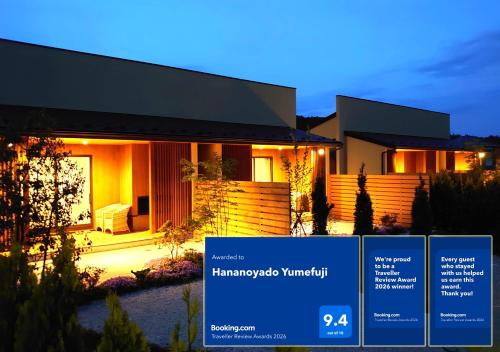
![]() Hananoyado YumefujiSituated in Fujikawaguchiko, 2.9 km from Lake Kawaguchi, Hananoyado Yumefuji features each room with a private garden with a terrace. Kawaguchiko Station is just a 5-minute walk away from the villa. Free WiFi is available throughout the property. At the hotel, all air-conditioned rooms are fitted with a wardrobe, a flat-screen TV and a private bathroom including free amenities. All rooms also boast a kitchenette with a fridge. Breakfast is served as morning basket (bento) daily at the property. A variety of popular activities are available in the area around the property, including skiing, cycling and hiking. Free public parking is available. On-site concierge service is available. Lake Kawaguchi Ohashi Bridge is 1.8 km from the accommodation. Fujikyu Highland is 1.17 km away.View on Booking.com
Hananoyado YumefujiSituated in Fujikawaguchiko, 2.9 km from Lake Kawaguchi, Hananoyado Yumefuji features each room with a private garden with a terrace. Kawaguchiko Station is just a 5-minute walk away from the villa. Free WiFi is available throughout the property. At the hotel, all air-conditioned rooms are fitted with a wardrobe, a flat-screen TV and a private bathroom including free amenities. All rooms also boast a kitchenette with a fridge. Breakfast is served as morning basket (bento) daily at the property. A variety of popular activities are available in the area around the property, including skiing, cycling and hiking. Free public parking is available. On-site concierge service is available. Lake Kawaguchi Ohashi Bridge is 1.8 km from the accommodation. Fujikyu Highland is 1.17 km away.View on Booking.com
-