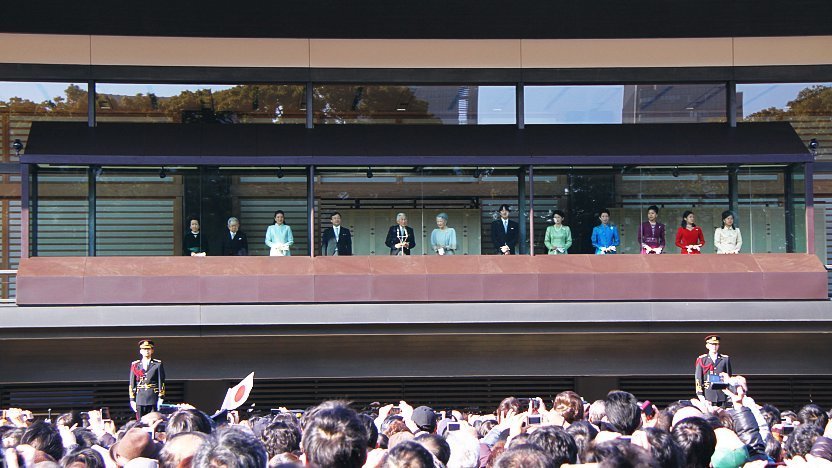
The Imperial Family during the New Year Greeting at the Tokyo Imperial Palace
According to mythology, Japan's first emperor, Emperor Jimmu, was a descendant of the Sun Goddess Amaterasu and enthroned in the year 660 BC. While the myths are not considered historically accurate, it is commonly accepted that emperors have reigned over Japan for more than 1500 years, and that they have all descended from the same family. The imperial crest is a 16-petaled chrysanthemum flower.
Despite the fact that the effective power of the emperors was limited or purely symbolic throughout most of Japan's history, all actual rulers, from the Fujiwara and Hojo regents to the Minamoto and Tokugawashogun respected the emperor and were keen in having the imperial legitimization for their position as rulers.
Imperial crest on a lantern
With the Meiji Restoration of 1868, the shogunate was overthrown, and Emperor Meiji became the head of state. Under the new constitution, the emperor held sovereign power, and his political and military power was theoretically close to absolute. In practice, however, the real power laid first with the oligarchs and later with the prime ministers, generals and admirals.
The postwar constitution of 1946 states that the emperor has only a symbolic function. He now mainly participates at ceremonies but has no effective political power. In 2019, Emperor Naruhito became Japan's 126th emperor. He is married to Empress Masako.
Places of interest related to the Imperial Family
Imperial palaces
Besides the current imperial palace in the center of Tokyo, there are a few other former palaces of the Imperial Family that are of interest to tourists. While most buildings cannot be entered, some of the palace grounds can be viewed by tourists.
The Tokyo Imperial Palace is situated in central Tokyo on the former grounds of Edo Castle, a short walk from Tokyo Station. It includes a large park area surrounded by the moats and impressive stone walls of the former castle. The outer palace grounds and the East Gardens are open to the public year round. The inner palace grounds can be visited on guided tours or without joining a tour on January 2 (New Year's Greeting) or December 23 (Emperor's Birthday).
The Kyoto Imperial Palace used to be the residence of the Imperial Family until 1868, when the capital was moved from Kyoto to Tokyo. It is today part of the spacious Kyoto Imperial Park. The palace is enclosed by long walls and consists of several gates, halls and gardens. The palace grounds can be explored freely, but the palace buildings cannot be entered.
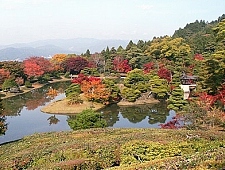
Also located in the Kyoto Imperial Park is the Sento Imperial Palace, which was built in 1630 as the retirement palace of Emperor Gomizuno, and became the palace for subsequent retired emperors. The original palace buildings have been lost over the years, and the main attraction today is the palace's beautiful strolling garden. The grounds can only be entered on guided tours.
The Heijo Palace (Nara Imperial Palace) served as the seat of the emperors during the Nara Period (710-794). After the capital was moved away, all of the palace's buildings were eventually lost with the exception of a single hall that now stands at Toshodaiji Temple. The palace grounds were for many years used as rice fields until recently, when a few structures of the former complex were rebuilt.
Imperial villas
Imperial villas were built as secondary homes and retreats for emperors or members of the Imperial Family. Several of them have been preserved or survive as parts of temple complexes.
The spacious Shugakuin Imperial Villa was built in the 17th century by Emperor Gomizuno. It is only accessible to the public through guided tours. The entire villa compound incorporates several buildings of Japanese design and architecture into a garden setting that includes a large pond, offering gorgeous scenery.
The Katsura Imperial Villa was completed in 1645 as the residence for the Katsura Family, members of Japan's Imperial Family. Visitors can view the celebrated villa (from the outside only) and its beautiful garden by joining a guided tour.
Ninnaji is an imperial villa turned temple in Kyoto, listed as a World Heritage Site. Members of the Imperial Family used to serve as Ninnaji's head priest, and the temple also became known as the Omuro Imperial Palace. Built in the style of an imperial palace, the graceful buildings of the complex are connected with each other by covered corridors. They feature elegantly painted sliding doors (fusuma) and are surrounded by beautiful rock and pond gardens.
Daikakuji Temple was originally built in the early 800s as the detached palace of Emperor Saga. After the emperor's death, the palace was converted into a temple. Several Buddhist statues, a small shrine and the Shingyo Pagoda, a two tiered, tahoto style pagoda erected to commemorate the 1150th anniversary of Emperor Saga writing the Heart Sutra, populate the garden grounds at the temple and are connected by a network of walking paths.
The building of the Tamozawa Imperial Villa served initially as the Tokyo residence of a Tokugawa branch family, which was later transformed into a retreat for the Imperial Family and subsequently moved to Nikko. It is one of the largest remaining wooden buildings in Japan, blending architectural styles of both the Edo and Meiji Periods. The villa now functions as a museum and memorial park, and is well equipped with multilingual displays for visitors.
Shrines which enshrine the spirits of former emperors
The spirits of some former emperors have been enshrined at shrines across Japan.
Hachiman, the Shinto god of archery and war, is identified as the deified 15th emperor of Japan, Emperor Ojin. There are thousands of shrines in Japan dedicated to Hachiman, of which the principle Hachimangu (Hachiman Shrine) is Usa Shrine on the Kunisaki Peninsula. The shrine's main hall is a National Treasure and the prototype of the Hachiman-zukuri style of shrine architecture.
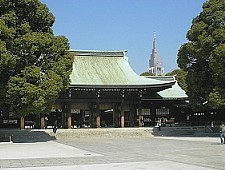
Meiji Shrine is dedicated to the deified spirits of Emperor Meiji and his consort, Empress Shoken. The large shrine grounds are forested and create a calm and serene environment in the center of the city. Meiji Shrine is one of Japan's most popular shrines, and it is visited by millions over the first days of each New Year.
Heian Shrine was completed in 1895 to commemorate the 1100th anniversary of the capital's foundation in Kyoto. It is dedicated to the spirits of the first and last emperors who reigned from the city, Emperor Kammu (737-806) and Emperor Komei (1831-1867). The shrine's main buildings are a partial replica of the original Imperial Palace from the Heian Period. Its garden is one of Kyoto's best cherry blossom spots.
The Kashihara Shrine was built in 1889 to enshrine Emperor Jimmu, Japan's first emperor. It is said that Jimmu ascended the throne at the spot where the shrine now stands. Emperor Meiji donated two buildings from the Kyoto Imperial Palace to the shrine when it was constructed, one of which is now used as the shrine's main hall.
The Imperial Regalia
The Imperial Regalia (sanshu no jingi) are the symbols of the legitimacy of the emperors and the most sacred objects in Shinto. They consist of a mirror, jewel and sword.
According to Japanese mythology, the sacred mirror was used to lure Amaterasu, the Sun Goddess, out of a cave where she had withdrawn after her brother Susanoo, the God of Seas, had misbehaved himself. The mirror is now stored at the Inner Shrine of Ise.
The sacred sword was discovered by Susanoo in the tail of an eight headed dragon that he had killed. The sword is now stored at the Atsuta Shrine in Nagoya.
Together with the mirror and the sword, the sacred jewel was handed by Amaterasu to her grandson Ninigi no Mikoto, when she sent him down to earth. He again handed the three regalia to his great-grandson Jimmu, who became the first emperor of Japan. The jewel is now stored at the Tokyo Imperial Palace.
Ise Shrine (left), Atsuta Shrine (center), Tokyo Imperial Palace (right)