Entering Japan
Below is a basic introduction to the Japanese immigration system. Contact your closest Japanese embassy or consulate outside Japan or an immigration bureau inside Japan for official advice.
All foreigners, including foreign residents, get fingerprinted and photographed upon entering Japan as a measure aimed at preventing terrorism and other illegal activities. Excluded from this procedure are persons under the age of 16 and a few special groups, such as diplomats and visiting dignitaries.
All foreigners receive a status of residence when entering Japan. There are more than twenty statuses of residence, including "temporary visitor" for tourists, and a range of statuses for students, workers and relatives of Japanese nationals and residents.
Tourists and business travelers (temporary visitors)
If you are a citizen of one of the over 50 countries with which Japan has a "general visa exemption arrangement", you need only a valid passport to enter Japan as a "temporary visitor". Otherwise, you need to obtain a visa before entering the country. Temporary visitors from most countries are allowed to stay for up to 90 days.
If you are a citizen of Austria, Germany, Ireland, Liechtenstein, Mexico, Switzerland or the United Kingdom, you have the possibility to extend your stay to a total of up to six months. You still initially enter Japan on a 90 day permit, but can then apply for an extension at an immigration bureau in Japan.
Visitors to Japan are encouraged to use Visit Japan Web to digitally submit immigration and customs-related information ahead of their arrival for a smoother entry into the country without the need to fill out paper forms. The system can be used to also create a tax exemption QR code for an enhanced tax-free shopping experience.
Japan plans to introduce an ESTA-style pre-registration system by March 2029. Temporary visitors entering under the visa-waiver program will be required to submit personal information and pay a fee prior to their arrival. Details will be announced at a later date.
Temporary visitors are not allowed to engage in any paid activities. However, short term studies at Japanese language schools are permitted.
All foreign tourists in Japan are required to carry their passports with them at all times.
Longer stays for the wealthy and digital nomads
If you are a citizen of one of the over 50 countries with which Japan has a "general visa exemption arrangement" and have savings of over 30 million yen, you and your spouse may qualify to stay in Japan for up to one year for the purpose of sightseeing and recreation. Likewise, professionals with an annual income of over 10 million yen may qualify to work remotely from Japan for up to six months. Respective visas (for "long-term residents for sightseeing/recreation" or "digital nomads") have to be obtained before traveling to Japan.
Working in Japan
White-collar work
Foreigners who wish to work in Japan need to get a work visa from a Japanese embassy or consulate outside of Japan to enter the country on a status of residence permitting work.
There are over a dozen such statuses of residence, each allowing the holder to work only in a specific professional field, for example, journalism, arts, research, education, engineering, entertainment, business management, international services, etc. If you change jobs while you are in Japan and your new job falls into a different professional field (e.g. from education to engineering), you will need to change your status of residence.
A university degree or considerable professional experience in the applicable field is required to qualify for most work visa types. Most also require you to have a prospective employer as a sponsor. Residence permission is granted in periods of 4 months to 5 years and is extendable.
Workers may bring their spouses and children to Japan on a dependent visa. Dependents are not allowed to engage in any paid activities unless they get permission from the immigration office, but even then, they may work only a set maximum number of hours per week.
Other work and trainees
The so-called "Specified Skills" status allows for work in one of over a dozen professional fields, including construction, hospitality, nursing and manufacturing. Applicants do not need a degree but have to pass a technical skills test and know some Japanese. There are two types: Type 1 allows workers to stay in Japan for up to five years, but they may not bring their family. Type 2 is for more highly qualified workers, can be extended indefinitely and allows for the family to live in Japan. Type 1 holders may upgrade to type 2 after five years.
Furthermore, there is the "Technical Intern Training Program", which lets foreign workers acquire skills at a workplace in Japan that they could not otherwise acquire in their home countries. After a few years, participants become eligible to switch to the above-mentioned "Specified Skill" type 1 status. Most trainees come from South East Asia.
Working holidays
This is a special visa type that allows some paid activity for citizens of Australia, Canada, Denmark, Germany, France, Ireland, Korea, New Zealand, the United Kingdom and a few other countries between the ages of 18 and 30. Consult the working holiday visa page for details.
Studying in Japan
Foreigners who wish to study in Japan (except for short term studies at language schools) need to get a student visa at a Japanese embassy or consulate outside of Japan in order to enter the country on a status of residence that permits long term studies.
Sponsorship from an educational institution in Japan and proof of sufficient funds to cover all your expenses during your stay are required to qualify for a student visa. Residence permission is granted in periods of between 3 months and 4 years and 3 months and is extendable.
Students must not engage in paid activities unless they get permission from the immigration office. Even then, students may work only a set maximum number of hours per week.
Spouses
Foreigners who are married to a Japanese national or to a permanent resident of Japan can obtain a spouse visa, which allows them to engage in any paid activity in Japan. Residence permission is granted in periods of 6 months or 1, 3 or 5 years and is extendable.
Staying in Japan
Inside Japan, most immigration-related matters, such as extending residence permission or changing the status of residence, are handled by the Immigration Services Agency, which has bureaus across the country.
Residence card
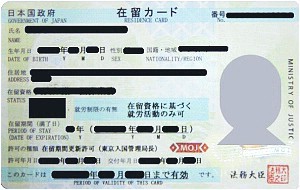
All new foreign residents are issued a residence card (zairyu card) upon initially entering Japan at Narita, Haneda, Kansai or Chubu airports. New residents arriving through different ports can get their cards at their municipal offices.
The residence card is an important document required for opening a bank account, obtaining a cell phone, converting a drivers license and similar activities. It stores the holder's personal information, including the current address, the status of residence and period of stay. Foreign residents are required to carry their residence card with them at all times.
Extending residence permission
Most statuses of residence allow you to stay in Japan for a period between three months and five years. If you wish to stay longer, you must apply for an extension at an immigration bureau inside Japan before the expiry date of your current residence permission.
The application process is relatively simple, provided that you still fulfill the conditions for the specific status of residence. It typically takes a couple of days or weeks for the application to be processed, and you are allowed to remain in Japan during that time even if your previous residence permission expires in the meantime.
Changing status of residence
It is possible to change your status of residence (e.g. from instructor to arts or from student to engineer) at an immigration bureau inside Japan. You will have to provide similar documentation as you would when applying for a new status of residence at an embassy or consulate outside of Japan.
Re-entry permits
Foreign residents who wish to temporarily leave Japan for longer than a year, need to get a re-entry permit before departing Japan; otherwise, they lose their status of residence. Re-entry permits can be obtained at immigration offices in Japan. For absences of less than one year, re-entry permits are not required.
Permanent residence
Foreign residents, who have shown good conduct and have sufficient assets or ability to make an independent living, can be granted permanent residence if they reside in Japan for a certain number of consecutive years. For highly-skilled professionals and spouses of Japanese nationals, the minimum amount of years is typically one to five years, while for others it is typically ten years. Permanent residence status is indefinite and allows for any paid activity.
Naturalization
Foreigners, who have resided in Japan for at least ten consecutive years (less if married to a Japanese national), have shown good conduct, have never plotted against the Japanese government, have sufficient assets or ability to make an independent living and are willing to renounce any other citizenship held, can be granted Japanese citizenship.
Questions? Ask in our forum.