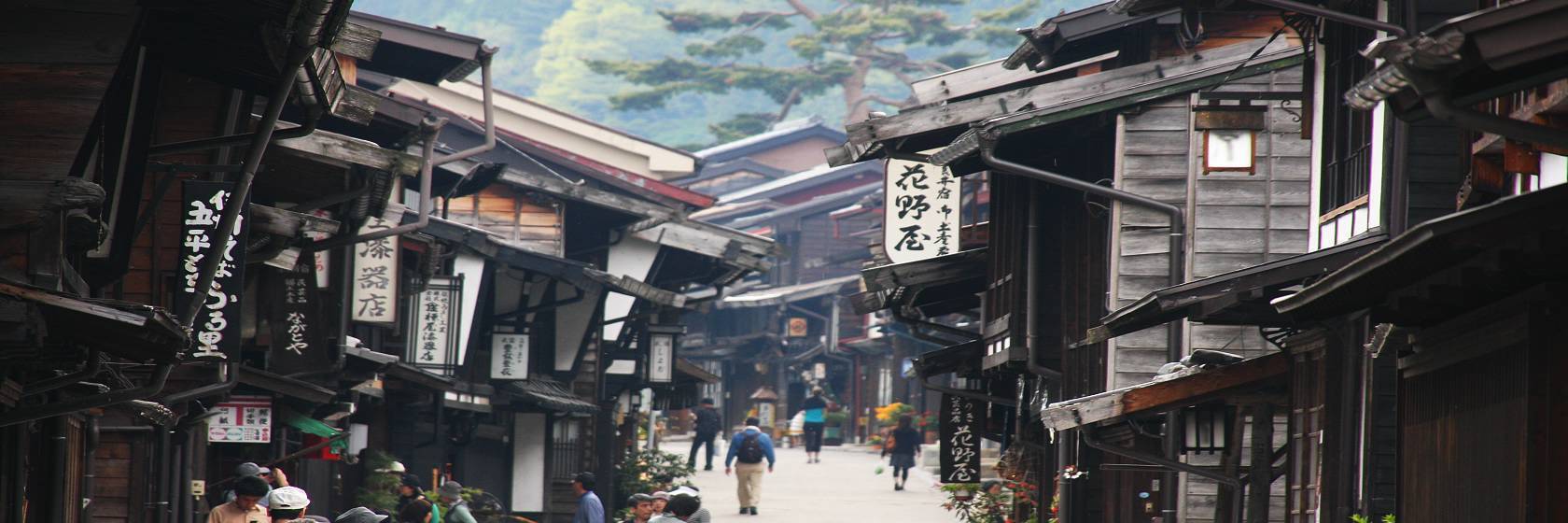
While many of Japan's historic buildings and districts have been lost due to fires, earthquakes, wars and city redevelopment, some cities and towns have managed to preserve a street block or whole district of traditional buildings for residents and tourists to enjoy today. The list below introduces some of Japan's best preserved historic city districts and towns:
Former samurai districts
Many Japanese cities, including Tokyo, Osaka and Nagoya, have developed as castle towns, where the local feudal lord resided in the centrally located castle, and his retainers, the samurai, lived in the districts surrounding the castle.
As the highest social caste during the Edo Period, the samurai were allowed to construct elaborate residences with earthen walls and elegant homes. Among the best preserved former samurai districts are the ones of Kakunodate, Hagi and Kanazawa.
-
Former Castle Town•
A few lanes, lined by the white walls and wooden gates of former
samurai mansions are beautifully preserved in the Jokamachi district of Hagi today. Some houses are open to the public.
-
Samurai District•
A beautifully preserved samurai district with several former
samurai mansions open to the public. Kakunodate's samurai district is famous for its many weeping
cherry trees.
-
Nagamachi•
Narrow lanes and old mansions are preserved in Nagamachi, one of Kanazawa's former
samurai districts. Kanazawa used to be the capital of the
Edo Period's second wealthiest feudal domain.
-
Kitsuki•
Kitsuki is unique for having two samurai districts on hills sandwiching a merchant district in the valley in between. They are among the most pleasantly preserved samurai districts in Japan.
-
Old Town
The highlight of
Tsuwano's old town is the Tonomachi district where one street block of the former samurai district is particularly nicely preserved with earthen walls, historic buildings and a water canal filled with carps.
-
Samurai District
The preserved area of Usuki's samurai district is small but photogenic. Referred to as Nioza Historical Road, it is about 200 meters long.
-
Samurai District
Some of Matsue's former samurai mansions have been preserved along the busy road north of
Matsue Castle. Among them is the former residence of Lafcadio Hearn.
Former merchant districts
In theory the lowest of the four social castes during the Edo Period, many merchants grew very wealthy towards the end of the feudal ages. Like other social castes, the merchants lived in assigned city districts. Merchant districts are characterized by shop-lined streets and warehouses (kura). Among the cities with the most beautifully preserved former merchant districts are Takayama and Kurashiki.
-
Old Town••
The narrow streets in Takayama's old town are lined by traditional buildings, shops and
sake breweries. A few former merchant homes are open to the public.
-
Canal Area•
Numerous warehouses are preserved along a willow lined canal. Many of the warehouses have been converted into museums, souvenir stores, boutiques and cafes.
-
Yokaichi Old Town•
A 600 meter long street lined by preserved buildings from the era when the small town of Uchiko on Shikoku gained international fame and wealth as wax producer.
-
Omi Hachiman•
In the old days, the merchants from Omi Province in today's
Shiga Prefecture were known nationwide for their business skills. Their home town,
Omi Hachiman, preserves a pretty old district around a picturesque canal.
-
Fukiya Village•
A nicely preserved village known for bengara color pigment that was gained from nearby copper mines. Part of its appeal is the village's remote location in the mountains one hour outside central
Takahashi.
-
Imaicho Town
Rather than just a district, Imaicho is a whole town whose machiya town house-lined streets have been preserved. A couple of merchant houses are open for tourists to enter.
-
Naramachi
Naramachi is the former merchant district of Nara, where several traditional warehouses and residential buildings have survived. One old residence is open to the public for free.
-
Warehouse District
More than a dozen massive warehouses, reminiscent of the
Edo Period, are preserved along Kawagoe's main street. Many of them are now housing stores and restaurants.
-
Sawara Town
A former transport hub for rice shipments into the capital, Sawara's historic center lies along a canal lined by a few preserved and restored traditional residences, merchant shops and warehouses.
-
Nakamachi
Nakamachi-dori is a street lined by several nicely preserved, old buildings, including a number of warehouses. Some of them house small shops, restaurants and ryokan.
Geisha districts
Traditional geisha districts are characterized by the wooden tea houses, in which the geisha perform during banquets. The most beautiful, traditional geisha quarters are found in Kyoto and Kanazawa:
-
Gion•
Gion's Hanami-koji Street and Shirakawa area are lined by beautiful old buildings, tea houses and restaurants. In the evenings, you may be able to spot a
geisha apprentice.
-
Higashi Chaya District•
Kanazawa has multiple geisha districts with several old tea houses, where
geisha are still performing at banquets today. Two tea houses are open to the public.
Post towns
Post towns were built along the country's highways, such as the Tokaido and Nakasendo, to accommodate and cater to travelers. Only a small number of former post towns have preserved their Edo Period appearance. The best among them is Tsumago in the Kiso Valley.
-
Tsumago••
A beautifully preserved post town along the old Nakasendo with most of the town's buildings dating back to the
Edo Period, when they served as lodgings and restaurants.
-
Magome•
Another nicely preserved post town, about 10 kilometers south of
Tsumago along the old Nakasendo. The two towns are connected by a nice
hiking trail.
-
Ouchijuku•
Ouchijuku is a post town along the Aizu-Nishi Kaido trade route, which connected
Aizu with
Nikko during the
Edo Period. It is located about 20 kilometers south of Aizu-Wakamatsu.
-
Narai•
The wealthiest former post town in the
Kiso Valley, Narai stretches over a whole kilometer. Unfortunately, vehicular traffic is not banned along the street.
Pilgrimage towns
For centuries, Japan's most important temples and shrines have attracted crowds of pilgrims and tourists, resulting in street blocks, city districts and whole towns, providing visitors with lodgings, food and souvenirs.
Farming towns
The vast majority of Japan's population in the Edo Period and before was made up of farmers who typically lived in simple, thatched roof buildings. While single old farm houses are preserved at open air museums, there are a few remote villages that have preserved an appearance of past centuries.
-
-
-
-
Miyama
Miyama is a rural town in the mountains north of
Kyoto. It features over two hundred thatched roof houses scattered across its idyllic countryside. Miyama's Kayabuki no Sato village records the highest percentage of thatched roof buildings of any town in Japan.
Port towns
Port towns have been accommodating the fishing and trading industries for centuries. Over time, some grew into large cities with major international ports, such as Nagasaki, Yokohama or Kobe, while others remained remote, small fishing villages. A few of them have preserved an atmosphere of bygone times.
-
Tomonoura•
Tomonoura is a picturesque port town situated at a bay in Hiroshima Prefecture facing the
Seto Inland Sea. It features an endearing fishing townscape and an old town center of many photogenic alleys lined by rustic old houses. In the past, merchant ships traveling along the Seto Inland Sea would dock at Tomonoura while waiting for a favorable tide.
-
Ine•
Ine is a unique fishing town of "boat houses" (funaya) located around a pretty bay. The houses traditionally incorporate garages for boats on their first floors and residential space on the upper floors.
-
Honjima Island•
Kasashima Town on
Honjima Island in the
Seto Inland Sea preserves several buildings from the
Edo Period. Honjima's former inhabitants controlled trade traffic across the Seto Inland Sea from the strategically well situated island.
-
Misumi West Port
Misumi West Port was a major shipping point for coal from the
Miike Coal Mines for only about a decade during the
Meiji Period before losing to the nearby Misumi East Port. Several historic buildings have survived until today and provide a pleasant atmosphere to visiting tourists.
-
Yunotsu Onsen
Yunotsu is now a pleasantly old-fashioned
hot spring town along the calm Sea of Japan coast. A few centuries ago the town's port saw large amounts of silver from the nearby
Iwami Ginzan silver mines shipped out.
Ryukyu villages
An independent kingdom for several centuries, the Ryukyu Islands became part of Japan as Okinawa Prefecture in 1879. Despite past assimilation efforts, the distinct Ryukyuan culture is proudly surviving today and has become one of Okinawa's main tourist attractions.
-
Taketomi Island•••
The small village consists almost entirely of traditional style, one-storied houses with red tiled roofs, stone walls, ample of lion like shiza statues and white sand roads.