Japan Domestic Air Tickets
Japan Guide Homepage
Travel
Living
A-Z
Forum
Jobs
Friends
Shopping
Essentials
-
Sightseeing
-
Hotels
-
Transportation
-
Shopping
-
Questions
Sign in for a personalized experience. Don't have an account yet? Sign up now.
Korean
Traditional Chinese
Simplified Chinese
 
Search this site

Hotel Reservations

(check-in)

Online Hostel Bookings
Hostels and inexpensive ryokan from $10 per night!
Car Rentals
Compact cars from around 4,000 Yen/day!

Related Pages
Travel
Sightseeing
Kumano

Kumano Kodo
Hongu Taisha
Hayatama Taisha
Nachi Taisha
Katsuura
Kushimoto
Shirahama
Kumano City

Shinto
Buddhism
World Heritage Sites

Kumano: Access and Orientation

Related Questions
Eating around Shirahama Beach,...
 4 reactions, last updated 30 days ago
Jellyfish time on Shirahama,...
 1 reaction, last updated 123 days ago

Japan Sightseeing Guide
Hokkaido
Sapporo
Otaru
Hakodate
Furano
Abashiri
Noboribetsu
Niseko
Lake Toya
Daisetsuzan
Shiretoko
Rishiri Rebun
Akan

Tohoku
Sendai
Matsushima
Hiraizumi
Akita
Kakunodate
Nyuto Onsen
Aomori
Hirosaki
Lake Towada
Shimokita Hanto
Dewa Sanzan
Aizu

Kanto
Tokyo
Yokohama
Kamakura
Nikko
Kinugawa
Hakone
Kawagoe
Kusatsu
Ikaho
Minakami
Narita

Chubu
Nagoya
Inuyama
Mt.Fuji
Fujigoko
Izu Peninsula
Nagano
Matsumoto
Kamikochi
Kiso Valley
Hakuba
Yudanaka
Sado Island
Takayama
Shirakawa-go
Gujo
Gero Onsen
Kanazawa

Kansai
Kyoto
Osaka
Nara
Kobe
Himeji
Kinosaki
Mount Koya
Kumano
Yoshino
Amanohashidate
Hikone
Iga Ueno
Ise Shima

Chugoku
Hiroshima
Miyajima
Onomichi
Okayama
Kurashiki
Matsue
Iwami Ginzan
Iwakuni
Yamaguchi
Hagi

Shikoku
Takamatsu
Kotohira
Naoshima
Matsuyama
Uchiko
Kochi
Tokushima
Naruto

Kyushu
Fukuoka
Dazaifu
Nagasaki
Kumamoto
Mount Aso
Minamata
Beppu
Miyazaki
Takachiho
Kagoshima
Kirishima
Yakushima

Okinawa
Honto
Miyako
Yaeyama

Survey
How can tourism in Japan be improved?
More foreign language information
Preserve natural and historic sites
Ease immigration requirements
Reduce cost of travel
Make sights less crowded
Other
No improvement needed
see results
Other Surveys:
Next trip to Japan
Improvements to Tourism
Financial Crisis
Ski Destination
Preferred way to stay at a ryokan
Purpose of visit
Most popular region
Have you recently entered Japan?

japan-guide.com newsletter
Keeping you up to date on Japan travel and living related issues and site updates. Click here to subscribe!

japan-guide.com forum
? Any questions? Ask them on the question forum!

Sponsored Listings
Japan - Order FREE Brochure!
About vacation plans and specialty travel.
Car Rental
The cheapest rates in Japan!
Tour Packages
Guided and individual tour plans.

 
most visited sights
# 5   of 8 sights
in Kumano
 
Home - Travel - Sightseeing Guide - Kumano
Hongu Taisha
 
basic information

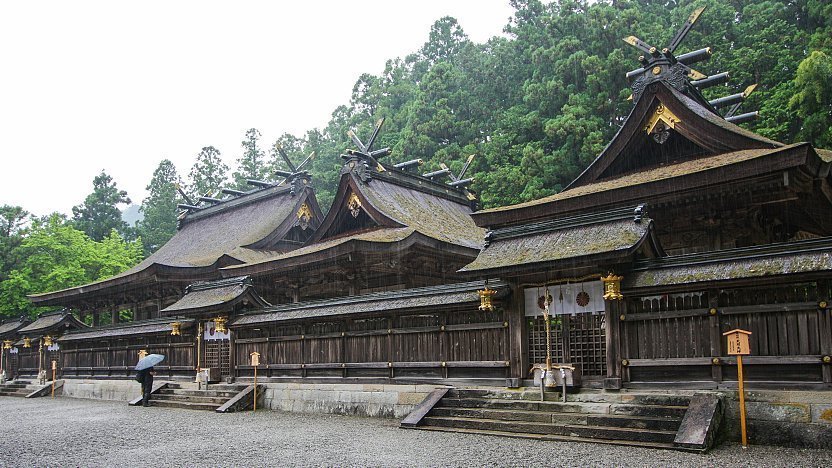
Kumano Hongu Taisha is one of the Kumano region's three famous shrines. As well as enshrining its own deity, Hongu Taisha also enshrines the deities of the other two Kumano shrines, Hayatama Taisha and Nachi Taisha, and the sun goddess Amaterasu. It serves as the head shrine of over 3000 Kumano shrines across Japan.

Reference to Hongu Taisha was first documented in the 9th century, which the establishment of the shrine must have preceded substantially. Due to floods in 1889, the shrine was moved from its original location at Oyu no Hara to its present site one kilometer away. In front of Oyu no Hara stands the biggest torii gate in the world, which, at 33 meters tall, dwarfs visitors passing under it.

Between Hosshinmon Oji and Hongu

Hongu Taisha is located at the center of the Kumano Kodo network of pilgrimage routes. An enjoyable walk for visitors who wish to experience a pilgrimage trail but are pressed by time, is the final section of the Nakahechi route between Hosshinmon Oji and Hongu. It is seven kilometers long, takes about two hours and finishes at the shrine. Hosshinmon Oji is accessible by bus.

There are three onsen (hot springs) near Hongu: Yunomine, Kawayu and Wataze. The first two are small onsen towns, while Wataze Onsen consists of only a single hotel complex, Watarase Onsen, which is known for having the largest outdoor bath in western Japan. The bath is also open to non staying guests.

Steam rises up from the rock riverbank of Kawayu
Tsuboyu in Yunomine Onsen

Kawayu Onsen is a unique hot spring town located along a river. To use the onsen, bathers dig a hole in the gravel riverbank into which hot spring water then flows. Cool river water is mixed with the hot onsen water to bring the water to a temperature particular to the bather's desire. In the winter, a giant rotenburo called the Sennin Bath is dug in the same manner, and is available for free public use.

Yunomine Onsen has such a long history that one of its baths, Tsuboyu, is designated as a UNESCO World Heritage Site. Pilgrims would perform purification rituals in the hot spring water as part of the religious process of their pilgrimage. Tsuboyu is one of two public bathhouses in Yunomine. The other is the nearby Yunomine Public Bathhouse, in which there are two separate bath areas.

The giant torii gate of Oyu no Hara

Any advice or questions? Voice them in the forum!

how to get there

From Tanabe and Shirahama

Six buses per day (four from December to mid March) connect Kii-Tanabe Station with Hongu Taisha. The one way trip takes two hours and costs 2000 yen. Some buses continue from Hongu to Hosshinmon Oji (10 minutes), the starting point of a pleasant two hour walk along the Nakahechi pilgrimage route to Hongu Taisha.

An additional two buses per day operate from Shirahama (town center, airport and railway station) to Hongu Taisha before continuing to Shingu Station. The one way trip from Shirahama Airport to Hongu Taisha takes 90 minutes and costs 2000 yen.

All of the above mentioned buses also stop at Takijiri Oji, the recommended starting point for the popular 2-day pilgrimage along the Nakahechi route to Hongu Taisha.

From Shingu Station

Buses for Hongu Taisha depart Shingu Station roughly once per hour. The one way trip costs 1500 yen and takes 80 minutes. Most buses stop at the three hot spring resorts of Kawayu, Wataze and Yunomine Onsen before arriving at Hongu Taisha.

From Gojo Station

Three buses per day make an epic 6.5 hour journey from Yamato-Yagi Station in Nara Prefecture to Shingu Station with stops along the way at JR Gojo Station and Hongu Taisha. The one way trip between Gojo Station and Hongu Taisha takes four hours and costs 4600 yen.

How to get to and around Kumano

hours and fees

Kumano Hongu Taisha
Hours:8:00 to 17:00
Closed:no closing days
Admission:free

Watarase Onsen (for non staying guests)
Hours:6:00 to 22:00 (admission until 21:30)
Closed:no closing days
Admission:700 yen

Kawayu Winter Rotenburo (Sennin Bath)
Hours:6:30 to 22:00
Closed:not available from March to October
Admission:free

Tsuboyu
Hours:6:00 to 21:30
Closed:no closing days
Admission:750 yen

Yunomine Public Bathhouse
Hours:6:00 to 22:00
Closed:no closing days
Admission:250 yen (regular bath)
380 yen (Kusuri bath)

travel community

Popularity of Hongu Taisha:
Users who have been to Kumano: 35
Users who have been to Hongu Taisha: 8

5th of 8 most visited sights in Kumano.
479th of 555 most visited sights nationwide.

Have you been to Hongu Taisha?

Ratings for Hongu Taisha:
japan-guide.com Rating:
  outstanding  
User Rating:
n/a
  insufficient data

User Feedback
We strive to keep japan-guide.com up-to-date and accurate, and are always looking for ways to improve the user experience. If you have any updates, suggestions, corrections or opinions, please let us know:

hotels & ryokan

In:
From:
For:
Website:

english links

Kumano Hongu
Official English website of the Hongu Tourism Association.
Tanabe City Kumano Tourism Bureau
English website by Tanabe City.

japanese links

Kumano Hongu
Official website of the Hongu Tourism Association.
Tanabe City Kumano Tourism Bureau
Website by Tanabe City.


September 16, 2008  
Copyright © 1996-2009 japan-guide.com All rights reserved
home - site map - privacy policy - terms of use - contact - L‚ɂ‚¢‚Ä - advertising

Asian-inspired
Plasma TV Stands